
10 best offshore bank accounts are transforming how entrepreneurs, e-commerce sellers, digital nomads, and global investors manage their finances in 2026. No longer constrained by domestic banking limitations, businesses can now access international financial systems with greater flexibility and control.
The best offshore bank accounts can unlock global payment infrastructure, protect assets, optimize tax positioning legally, and provide the financial foundation needed to scale across borders – seamlessly.
But choosing the right offshore account is no small decision. The wrong jurisdiction, the wrong bank, or an incomplete application can cost you weeks – and thousands of dollars – in delays, rejected applications, and compliance headaches.
In this guide, we have done the heavy lifting for you. We review the 10 best offshore bank accounts available in 2026, covering everything from traditional private banking giants to modern digital-first solutions. We evaluate each on key criteria: stability, fees, digital access, multi-currency support, remote opening capability, and compliance standards.
Whether you are an Amazon seller struggling with payment gateway restrictions, a freelancer building a global client base, or a high-net-worth investor looking for support asset protection strategies – this guide will help you make a confident, informed decision.
| Who This Guide Is For: • E-commerce sellers (Amazon, Shopify, Etsy, eBay) • Freelancers and digital consultants • International traders and importers/exporters • Tech startups seeking global banking infrastructure • Investors and high-net-worth individuals seeking asset protection and wealth preservation |
Table of Contents,
- 1 What Is an Offshore Bank Account?
- 2 Why Open an Offshore Bank Account in 2026?
- 3 10 Criteria for Choosing the Best Offshore Bank Account
- 4 The 10 Best Offshore Bank Accounts in 2026
- 4.1 #1 Speedy Incorp Banking Solutions – Best Overall for Global Entrepreneurs
- 4.2 What Speedy Incorp Offers
- 4.3 #2 Standard Chartered International Banking
- 4.4 #3 HSBC Premier Offshore Account
- 4.5 #4 Citibank International Personal Banking
- 4.6 #5 Bank of Singapore Private Banking
- 4.7 #6 UBS Switzerland – The Gold Standard in Private Banking
- 4.8 #7 Mashreq Neo Global Account (UAE)
- 4.9 #8 Banco Atlántida – Cayman Islands
- 4.10 #9 Bank of Cyprus International Banking
- 4.11 #10 Wise Multi-Currency Business Account
- 5 Side-by-Side Comparison: The 10 Best Offshore Bank Accounts (2026)
- 6 How to Open an Offshore Bank Account in 2026: Step-by-Step
- 7 Our Recommendation: The Right Account for Your Situation
- 8 Conclusion
What Is an Offshore Bank Account?
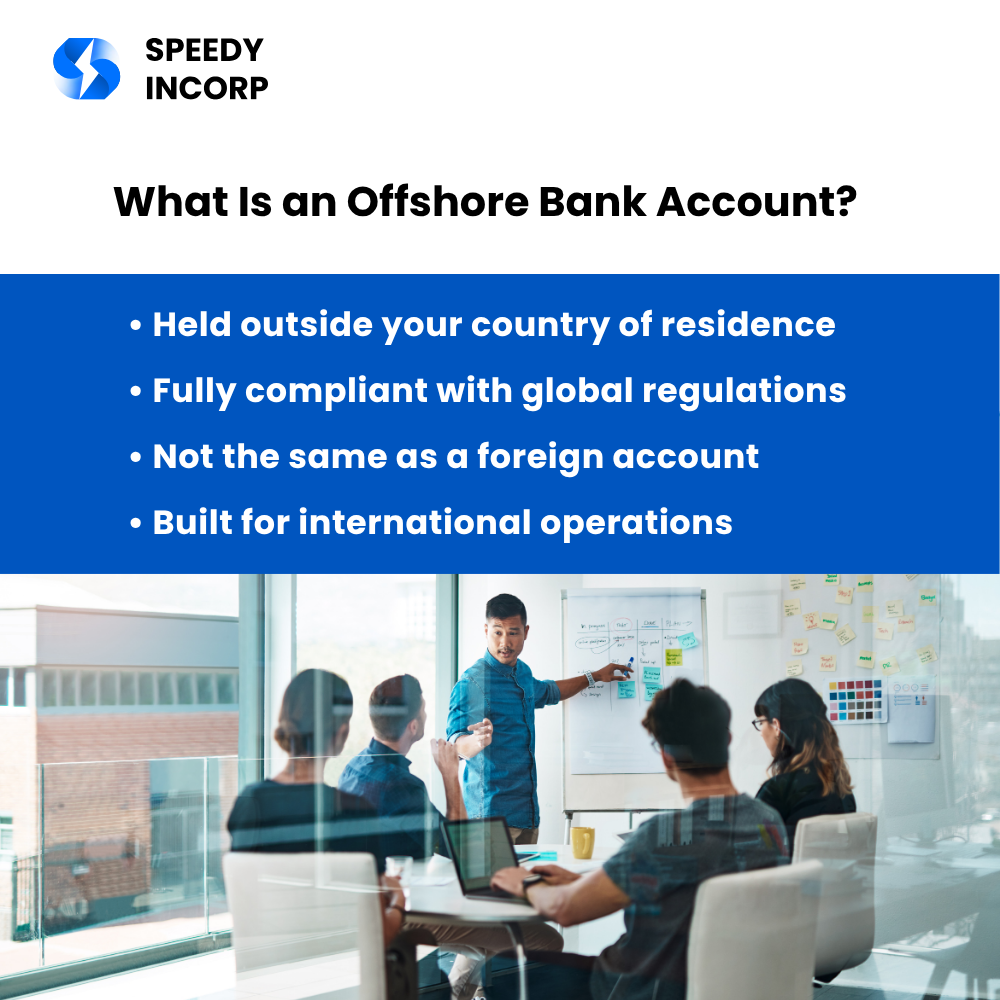
An offshore bank account is a bank account held in a jurisdiction other than your country of residence or the country where your business is legally registered. In plain terms: it is a bank account abroad, can be maintained in compliance with international financial regulations.
Contrary to popular belief, offshore banking is not a grey area. The IMF, FATF, and OECD set global standards for transparency, anti-money laundering, and tax compliance. Under Basel III standards, international banks are held to strict capital adequacy, liquidity, and compliance requirements -adopted (with variations) across most major banking jurisdictions.
The distinction between an “offshore” and a “foreign” account is subtle but important. A foreign account simply means an account held in another country. An offshore account specifically implies an account structured to take advantage of the legal, tax, and privacy frameworks that a particular jurisdiction offers – within the boundaries of international law.
Common Misconceptions – Set Straight
- “Only for the ultra-wealthy.” FALSE: While traditional offshore banks often require higher minimum deposits, some modern digital solutions such as Wise offer low or no minimum balance accounts.
- “It is tax evasion.” FALSE: Offshore banking is fully legal. Tax optimization can be legitimate when properly structured and compliant with local laws. Tax optimization using legal structures across jurisdictions is entirely legitimate and widely practiced by global corporations.
- “Complete secrecy.” FALSE: FATCA and CRS (Common Reporting Standard) mean most offshore jurisdictions now share financial data with home tax authorities. Privacy is not the same as secrecy.
- “Many modern providers allow remote onboarding, although some traditional banks may still require in-person verification”. FALSE: Many banks and service providers, including Speedy Incorp, offer fully remote account opening supported by digital KYC verification.
- “It is illegal.” FALSE: Offshore banking is legal in virtually every country, provided the account holder properly reports the account to their home tax authority.
Why Open an Offshore Bank Account in 2026?
The case for offshore banking has never been stronger. Global trade volumes, cross-border e-commerce, and remote work have all surged. At the same time, domestic banking infrastructure in many countries has failed to keep pace with the needs of internationally-minded entrepreneurs. Here is why the best offshore bank account can be a game-changer for your business.
Asset Protection and Wealth Preservation
Political instability, currency devaluation, and even frivolous litigation can threaten assets held exclusively in a domestic account. Offshore banking distributes your financial exposure across multiple jurisdictions, providing a legally recognized layer of protection. In stable jurisdictions like Singapore, Switzerland, or the UAE, deposit insurance schemes and robust banking secrecy laws (compliant with CRS) provide an additional safety net.
Multi-Currency Management
For any business operating internationally, currency conversion costs are a silent profit killer. A single offshore account supporting 20, 30, or even 50+ currencies allows you to receive payments, hold funds, and pay suppliers in local currencies – eliminating unnecessary FX conversion fees. An e-commerce seller receiving USD from US customers and EUR from European clients can manage both from a single offshore account at near-interbank exchange rates.
Legal Tax Optimization
Disclaimer: Nothing in this guide constitutes tax advice. Always consult a qualified tax professional for your specific situation.
That said, legitimate tax optimization strategies – including income deferral, treaty benefits, and structuring income through appropriate legal entities – are widely used by businesses operating internationally. Jurisdictions like the UAE (0% personal income tax) and Singapore (territorial tax system) offer significant structural advantages for businesses with genuine commercial presence.
The key is compliance: proper reporting under FATCA and CRS, along with transparent structuring supported by qualified advisors. For further details on global compliance frameworks such as FATCA and CRS, refer to the official guidelines published by the Organisation for Economic Co-operation and Development.
Access to Global Payment Systems
This is the pain point most felt by e-commerce sellers. Stripe, PayPal, and major payment processors restrict or outright refuse accounts from certain nationalities or jurisdictions. A legitimate offshore company – particularly one registered in the US (Delaware/Wyoming) or UK – paired with the right offshore bank account, can significantly improve access to global payment infrastructure. This is precisely the problem Speedy Incorp solves for thousands of clients every year.
Enhanced Financial Privacy
Privacy and secrecy are different things. A compliant offshore account in Singapore or Switzerland may not shield your identity from your home tax authority (CRS compliance ensures reporting), but it does protect your financial data from data breaches, identity theft, and unnecessary public exposure. Bank-level encryption, advanced KYC standards, and robust privacy laws in stable jurisdictions mean your financial information is handled with a level of care that many domestic banks cannot match.
10 Criteria for Choosing the Best Offshore Bank Account
Before we dive into our rankings, here is the framework we used to evaluate every option on this list. Apply these 10 criteria to your own situation before making any decision.
- Political and Economic Stability of Jurisdiction: Choose jurisdictions with high scores on the Political Stability Index and Economic Freedom Index. Singapore, Switzerland, UAE, UK, and the US consistently top these rankings.
- Banking Secrecy and Privacy Laws: Understand the level of privacy protection offered – and its limits under CRS/FATCA. Stronger privacy jurisdictions include Singapore, Switzerland, and Cayman Islands.
- Deposit Insurance Coverage: Confirm how much of your deposit is insured. Singapore insures up to SGD 75,000; UK up to GBP 85,000; EU member states up to EUR 100,000.
- Minimum Deposit and Fee Structure: These range from $0 (Wise, Mashreq Neo) to $1M+ (UBS Private). Understand annual maintenance fees, transaction fees, and waiver conditions.
- Multi-Currency Support: For international businesses, holding and transacting in multiple currencies is essential. Look for accounts supporting 15+ currencies at minimum.
- Remote Account Opening: In 2026, fully remote account opening via video KYC is increasingly standard – but not universal. Banks requiring in-person visits add significant friction and cost.
- Digital Banking Infrastructure: Mobile app quality, API integrations, real-time notifications, and cybersecurity standards all matter for day-to-day operations.
- International Transfer Speed and Cost: SWIFT transfers remain dominant but can be slow and expensive. Look for banks with SEPA access (for EUR), faster payment rails, or fintech alternatives.
- Reputation and Financial Strength: Check Moody’s, S&P, or Fitch ratings where available. Regulatory violation history and client reviews also matter significantly.
- FATCA and CRS Compliance: Any reputable offshore bank should be fully compliant. Non-compliant institutions expose you to significant legal and reputational risk.
The 10 Best Offshore Bank Accounts in 2026
Our rankings are based on the 10 criteria above, weighted by the needs of the core audience: international entrepreneurs, e-commerce sellers, freelancers, and investors. We have deliberately prioritized accessibility, compliance, digital capability, and practical business utility.
#1 Speedy Incorp Banking Solutions – Best Overall for Global Entrepreneurs
| Why Speedy Incorp Ranks #1 Speedy Incorp is not a bank – it is your strategic partner in navigating the entire offshore banking process. While traditional banks hand you a form and wish you luck, Speedy Incorp guides you from jurisdiction selection through account activation, with a dedicated team who understands the compliance landscape in 25+ countries. |
Founded by Ashley Phuong, a seasoned entrepreneur who built Speedy Incorp from the ground up while raising a family, the company was born from a deeply personal understanding of the challenges international entrepreneurs face. The mission is simple: make legal, transparent global business setup accessible to anyone – whether you are in Vietnam, Japan, Singapore, or anywhere else in the world.
What Speedy Incorp Offers
- End-to-End Service: From free consultation to account activation, Speedy Incorp handles every step of the offshore banking process.
- 25+ Jurisdictions: Including Singapore, UK, UAE (Dubai Free Zones), Hong Kong, US (Delaware and Wyoming), and Cayman Islands.
- Company Formation + Banking: Speedy Incorp uniquely combines offshore company registration with bank account opening – a seamless, integrated solution.
- Multi-Currency Accounts: Access to 40+ currency accounts depending on jurisdiction and banking partner.
- Compliance Expertise: Full FATCA and CRS compliance guidance, ensuring your structure is legally sound from day one.
- Transparent Pricing: Clear and transparent pricing with no hidden service fees.
- Human-Centered Support: Dedicated account managers, multilingual team, and responsive communication – because your business journey deserves a trusted friend, not a faceless portal.
The Speedy Incorp Account Opening Process
- Free Consultation – Understand your goals, business type, and jurisdiction options.
- Jurisdiction and Banking Partner Selection – Speedy Incorp recommends the optimal structure based on your situation.
- Document Preparation – Speedy Incorp provides a complete checklist and reviews your documents before submission.
- Application Submission – The team submits and liaises directly with the bank on your behalf.
- Compliance Screening Support – Speedy Incorp helps address any additional due diligence requests.
- Account Activation – You receive your banking credentials and onboarding support. Typical timeline: 2 to 6 weeks.
Who Should Use Speedy Incorp
Speedy Incorp is the right choice if you are new to offshore banking and need expert guidance, if you have been rejected by a bank due to documentation issues, if you want company formation and banking handled together, or if you need a compliant, efficient solution for your e-commerce, consulting, or investment business.
| Strengths | Considerations |
| End-to-end, guided process 25+ jurisdictions coverer Company Formation + banking integrated Transparent, no hidden fees Human-centered, responsive team | Service fees apply (offset by success rate and time savings) Timeline depends on jurisdiction and bank requirements |
#2 Standard Chartered International Banking
Standard Chartered is one of the most recognized names in international banking, operating across 60+ countries with deep roots in Asia, Africa, and the Middle East. Its International Banking proposition is built for globally mobile individuals and businesses.
- Key Features: 15+ currency support, Priority Banking tiers with dedicated relationship managers, access to investment products and insurance.
- Remote Opening: Online application available in select markets; video verification supported in some regions. Documentation requirements are thorough – plan for 3 to 4 weeks processing.
- Minimum Balance: $50,000 to $200,000 depending on account tier. Monthly fees of $30 to $50, waived if minimum balance is maintained.
- Best For: High-net-worth individuals and established businesses seeking a reputable traditional bank with a strong regional network.
Strength: Global brand credibility, extensive network. Consideration: High minimum balances make it inaccessible for early-stage entrepreneurs.
#3 HSBC Premier Offshore Account
HSBC Premier is the flagship international banking offering from one of the world’s largest financial institutions. With presence in 64 countries, HSBC Premier clients can access their account, transfer funds, and receive relationship banking support globally – often at no additional cost between HSBC branches.
- Eligibility: Annual income of $100,000+ or $100,000+ in assets under management with HSBC. Strict document requirements.
- Premium Services: Dedicated relationship manager, airport lounge access, preferential exchange rates, investment advisory services, and estate planning support.
- Remote Opening: Partially available; some markets require an initial in-person visit.
- Best For: Established high-net-worth individuals, expats, and business owners who want premium banking with global consistency.
Strength: Truly global infrastructure and premium service ecosystem.
Consideration: High entry requirements and bureaucratic onboarding process.
#4 Citibank International Personal Banking
Citibank’s International Personal Banking (IPB) platform is one of the most digitally sophisticated offshore banking options available from a traditional institution. The Citi Mobile app is consistently rated among the best in the industry, offering real-time notifications, instant internal transfers, biometric security, and integrated investment access.
- Account Tiers: International Personal ($50K minimum) | Citigold ($200K minimum) | Citigold Private Client ($1M minimum). Benefits scale with tier – from basic international access to dedicated wealth advisory.
- Cross-Border Features: Global Wallet multi-currency debit card, international wire capabilities, and access to Citigold’s global network.
- Digital Platform: Among the best mobile banking experiences for offshore accounts in 2026.
- Best For: Digitally-oriented business owners and investors who want traditional banking credibility with modern infrastructure.
Strength: Exceptional digital platform and tiered service model.
Consideration: Minimum balance requirements at upper tiers are significant.
#5 Bank of Singapore Private Banking
Bank of Singapore (BOS) is the private banking arm of OCBC Bank – and it is consistently ranked among Asia’s leading private banks. For high-net-worth clients seeking exposure to Asian markets, BOS offers an unmatched combination of regional expertise and global reach.
- Minimum Entry: $1.5M in investable assets. This is firmly in the private banking / family office territory.
- Asian Market Advantage: Deep expertise in Asian equities, ASEAN investment products, Greater China capabilities, and regional real estate financing.
- Wealth Management: Discretionary portfolio management, alternative investments, succession planning, and trust structuring support.
- Privacy: Singapore’s banking secrecy laws (compliant with CRS) provide a respected legal framework for financial privacy.
- Best For: Ultra-high-net-worth individuals and family offices seeking Asian market exposure and sophisticated wealth management services.
Strength: Unrivalled Asian market expertise and private banking quality.
Consideration: Extremely high entry threshold – not suitable for SMEs or early-stage entrepreneurs.
#6 UBS Switzerland – The Gold Standard in Private Banking
UBS is synonymous with Swiss private banking – and for good reason. With over 160 years of history and a reputation built on financial stability, discretion, and investment expertise, UBS remains the benchmark for ultra-premium offshore banking.
- Minimum Entry: $500,000 to $1,000,000+. In-person visits to Switzerland are typically required.
- Investment Services: Access to UBS Chief Investment Office research, structured products, hedge fund platforms, and even art and collectibles advisory services.
- Swiss Stability: CHF (Swiss Franc) remains one of the world’s most stable reserve currencies. UBS’s capital adequacy ratios consistently exceed regulatory minimums.
- Processing Time: 4 to 8 weeks, with extensive enhanced due diligence documentation required.
- Best For: Ultra-high-net-worth individuals seeking the ultimate in financial privacy, investment sophistication, and institutional stability.
Strength: The gold standard of private banking – unmatched pedigree.
Consideration: Extremely high entry costs, in-person requirements, and lengthy onboarding.
#7 Mashreq Neo Global Account (UAE)
Mashreq Neo is one of the most compelling options for digital-native entrepreneurs in 2026. Based in Dubai – a globally recognized zero-tax financial hub – Mashreq Neo offers 100% digital account opening, often activated within days. This is the fastest offshore banking solution on this list.
- Zero Tax Advantage: UAE levies 0% personal income tax and 0% capital gains tax. For businesses incorporated in UAE Free Zones, significant corporate tax benefits also apply (within regulatory boundaries).
- Digital-First: 100% digital onboarding, AI-powered mobile app, instant virtual debit card, and near-zero minimum balance requirements ($0 to $3,000 depending on account type).
- Processing: Days, not weeks. This is exceptional compared to traditional banks.
- Best For: Startups, digital entrepreneurs, freelancers, and anyone who needs a fast, cost-effective offshore banking solution in a zero-tax jurisdiction.
Strength: Unbeatable speed of setup and UAE tax advantages.
Consideration: Newer institution with shorter track record than traditional private banks.
#8 Banco Atlántida – Cayman Islands
The Cayman Islands has long been one of the world’s most established offshore banking jurisdictions. A tax-neutral, USD-based economy with strong asset protection laws makes it a perennial favourite for international investors and corporations. Banco Atlántida’s Cayman offering provides access to these structural benefits with a relatively accessible entry point.
- Minimum Deposits: $10,000 for personal accounts; $25,000 for corporate accounts. Trust accounts are also available.
- Asset Protection: Strong Cayman law creditor protection mechanisms. Accounts are not part of any public registry; court orders are required for disclosure.
- Tax Neutrality: The Cayman Islands imposes no income tax, capital gains tax, or withholding tax on account holders.
- Best For: Investors and corporations seeking a well-established offshore jurisdiction with robust asset protection and tax neutrality.
Strength: Strong legal asset protection framework in a globally recognized jurisdiction. Consideration: Less digital infrastructure than newer fintech-oriented options.
#9 Bank of Cyprus International Banking
As a European Union member state, Cyprus offers a genuinely compelling value proposition for businesses seeking EU market access without the high minimum balances of private banking. Bank of Cyprus provides SEPA-compatible euro accounts, SME-friendly fee structures, and a functional e-banking platform – all from a jurisdiction within the EU regulatory framework.
- Minimum Entry: From $5,000 – one of the most accessible traditional offshore banking options on this list.
- EU Access: SEPA transfers, EUR-denominated accounts, and access to EU-wide investment products. For businesses wanting to trade with European partners, Cyprus is strategically positioned.
- SME Focus: Trade finance services, multi-currency business accounts, and integrated payment solutions designed for small and medium enterprises.
- Best For: SMEs, European-focused businesses, and entrepreneurs seeking EU access with a lower financial barrier to entry.
Strength: EU access with low minimums – excellent value proposition.
Consideration: Cyprus has faced reputational headwinds post-2013 banking crisis, though the regulatory environment has significantly strengthened since.
#10 Wise Multi-Currency Business Account
Wise (formerly TransferWise) is technically not a bank – it is an Electronic Money Institution (EMI) licensed in multiple jurisdictions. But for freelancers, digital nomads, and SMEs, it functions as the most practical, accessible, and cost-transparent ‘offshore-style’ banking alternative available in 2026.
- Key Features: 50+ currencies supported, local account details in 10+ countries (USD, GBP, EUR, AUD, SGD, and more), Wise debit card, and instant account opening.
- Transparent Fees: Mid-market exchange rates with transfer fees typically between 0.35% and 1%. No monthly fees. No minimum balance.
- Limitations: Not a bank – funds are not deposit-insured in the traditional sense. No investment products or lending. Lower transaction limits compared to traditional banks. Not a substitute for a full offshore corporate banking solution.
- Best For: Freelancers, digital nomads, and early-stage SMEs who need multi-currency access immediately and cannot yet meet minimum balance requirements of traditional offshore banks.
Strength: Zero barrier to entry, instant setup, and genuinely transparent pricing. Consideration: Not a bank – it does not carry the credibility or full capabilities of a licensed offshore banking institution.
Side-by-Side Comparison: The 10 Best Offshore Bank Accounts (2026)
Use this table to quickly compare the key parameters across all ten options reviewed in this guide.
| Provider | Min. Deposit | Remote Opening | Multi-Currency | Best For | Processing Time |
|---|---|---|---|---|---|
| Speedy Incorp | $0 (service fee) | ✓ Yes | Multi | All businesses | 2–6 weeks |
| Standard Chartered | $50K–$200K | Partial | 15+ currencies | HNW individuals | 3–4 weeks |
| HSBC Premier | $100K assets | Partial | Multi | Expats & HNW | 3–5 weeks |
| Citibank IPB | $50K–$1M | Partial | Global Wallet | Cross-border | 2–4 weeks |
| Bank of Singapore | $1.5M investable | Limited | Multi | UHNW & family office | 4–8 weeks |
| UBS Switzerland | $500K–$1M | No (in-person) | Multi + CHF | Private wealth | 4–8 weeks |
| Mashreq Neo (UAE) | $0–$3K | ✓ 100% digital | Multi | Startups & digital nomads | Days |
| Banco Atlántida | $10K–$25K | Partial | USD-based | Asset protection | 2–4 weeks |
| Bank of Cyprus | $5K | Partial | EUR + multi | EU access & SMEs | 2–3 weeks |
| Wise | $0 | ✓ Yes (instant) | 50+ currencies | Freelancers & nomads | Minutes |
Note: Minimum deposits, fees, and processing times are indicative and subject to change. Always confirm current requirements directly with the institution or your service provider.
How to Open an Offshore Bank Account in 2026: Step-by-Step
The offshore account opening process has become considerably more streamlined over the past five years – but it still requires careful preparation. Here is the process, broken into five phases.
Phase 1: Define Your Objectives and Select Your Jurisdiction
Before choosing a bank, define what you actually need. Are you primarily looking for payment gateway access? Tax optimization? Asset protection? Multi-currency management? Your objectives should drive your jurisdiction selection. An e-commerce seller wanting Stripe access needs a different structure than a high-net-worth investor seeking wealth preservation.
- Document your banking objectives clearly
- Research 3 to 5 jurisdictions against the 10 criteria outlined earlier in this guide
- Consider tax implications with a qualified advisor
- Evaluate whether to use a service provider like Speedy Incorp to navigate the process
Phase 2: Prepare Your Documentation
Documentation is where most applications fail. Banks have become increasingly rigorous in their KYC (Know Your Customer) and AML (Anti-Money Laundering) requirements. Prepare the following:
- Valid passport – color copy of all pages, often requiring notarization or apostille
- Proof of address – recent utility bills or bank statements (within 3 months)
- Source of funds documentation – bank statements, payslips, business financials, or investment records
- Business documents – Certificate of Incorporation, Articles of Association, business plan
- Professional or bank references – letters from existing financial institutions or professional advisors
- Tax identification numbers – for FATCA/CRS compliance
| Pro Tip from Speedy Incorp Incomplete or poorly formatted documentation is the #1 reason offshore bank applications are delayed or rejected. Speedy Incorp provides a jurisdiction-specific document checklist and reviews all documents before submission – significantly reducing the risk of rejection and cutting processing time. |
Phase 3: Application Submission and KYC Verification
Once your documents are prepared, you will submit your application – either directly to the bank or through a service provider. Expect an initial review period of 3 to 7 business days, during which the bank’s compliance team will conduct background checks. You may be asked follow-up questions about the source of your funds, the nature of your business, or the purpose of the account. Answer promptly and clearly.
Many banks now offer video KYC verification as an alternative to in-person visits – accelerating the process significantly. Mashreq Neo and Wise, for example, complete this step entirely digitally.
Phase 4: Initial Funding and Account Activation
Upon approval, you will receive instructions to fund your account with the initial deposit. This must come from an account in your name – banks will request confirmation of the source. Once the deposit clears, your account is activated. You will receive your online banking credentials, and your debit card (if applicable) will be issued within 5 to 14 business days.
Phase 5: Setting Up Online Banking
Take time to configure your account properly from day one: set up two-factor authentication, configure spending alerts, add authorized beneficiaries, and run a small test transaction. If you are using a business account, connect it to your payment gateway and accounting software.
Expected Timelines
- Digital-first accounts (Wise, Mashreq Neo): Minutes to 3 business days.
- Traditional offshore banking (Standard Chartered, HSBC, Citibank): 3 to 6 weeks.
- Private banking (UBS, Bank of Singapore): 4 to 8 weeks, with in-person requirements.
- With Speedy Incorp: Average timeline reduced by 30% through proactive document preparation and direct bank liaison.
Our Recommendation: The Right Account for Your Situation
There is no single “best” offshore bank account – only the best account for your specific situation. Here is our quick-reference guide based on the most common profiles we see:
| Your Profile | Our Recommendation |
| E-commerce seller (Amazon/Shopify/Etsy) | Speedy Incorp + US or UK company + business bank account. Unlocks Stripe/PayPal access and payment gateway trust. |
| Freelancer or digital nomad | Wise for immediate multi-currency access + Speedy Incorp for a proper corporate structure when ready to scale. |
| International trader / importer-exporter | Speedy Incorp + Singapore or Hong Kong company + Standard Chartered or local bank account for trade finance access. |
| Startup seeking global payment infrastructure | Speedy Incorp + UAE Free Zone company + Mashreq Neo for fast, cost-effective digital banking. |
| High-net-worth individual (asset protection) | Speedy Incorp advisory + Bank of Singapore or UBS Switzerland, depending on asset levels and regional focus. |
| SME seeking EU market access | Speedy Incorp + UK or Cyprus structure + Bank of Cyprus for SEPA-compatible euro accounts. |
Conclusion
In 2026, the best offshore bank account is not just a financial product – it is the foundation of your global business strategy. Whether you need to unlock payment gateways, protect your assets, manage multiple currencies, or position your business for international credibility, the right offshore structure gives you the freedom to operate without borders.
The options reviewed in this guide range from the instantly accessible (Wise, Mashreq Neo) to the exclusively premium (UBS Switzerland, Bank of Singapore). Each has its place. The key is matching the account to your objectives, your current stage of business, and your long-term ambitions.
If you are new to offshore banking, or if you have been navigating this landscape on your own without success, the single most impactful decision you can make is to work with a knowledgeable, trustworthy partner. That is what Speedy Incorp was built to be.
| Ready to Open Your Offshore Bank Account? Let’s Talk. Speedy Incorp offers a free confidential consultation to help you identify the right jurisdiction, structure, and banking partner for your situation. Our team has supported clients from Vietnam, Japan, Singapore, Hong Kong, the UAE, the UK, and beyond. Website: speedyincorp.com Email: info@speedyincorp.com WhatsApp: +44 7468 651514 Hotline: +44 20 3996 1739 Address: Dalton House, 60 Windsor Ave, London SW19 2RR, United Kingdom |
Legal Disclaimer
This guide is provided for informational purposes only and does not constitute legal, tax, or financial advice. Offshore banking regulations, minimum requirements, and fee structures are subject to change. Always consult qualified legal and tax professionals before establishing any offshore corporate or banking structure. Speedy Incorp provides business formation and banking facilitation services – it is not a licensed bank or financial institution.